

The conflict has led to a de facto closure or severe disruption of the Strait of Hormuz, a critical maritime route for 20% of global oil supplies. Brent crude oil prices surged over 10% in today’s trading, surpassing the $80 per barrel mark, while natural gas futures also saw significant gains. In an effort to calm global markets, OPEC+ members, including Russia, have reached a preliminary agreement to increase output starting in April to stabilize energy supplies.
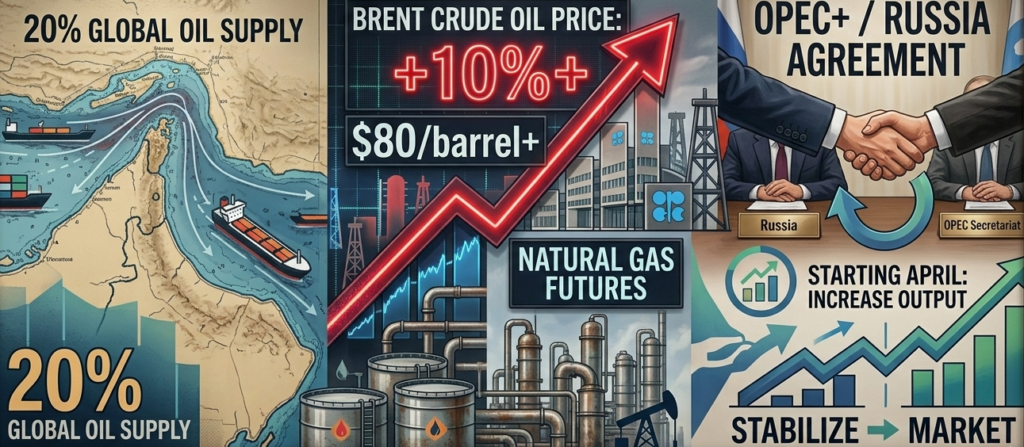
The closure of the Strait of Hormuz is confirmed true. On the evening of February 28, Iran’s Islamic Revolutionary Guard Corps officially announced a “ban on all vessels passing through the Strait of Hormuz.” Real-time data from international oil tanker traffic monitoring systems show that vessel speeds in the waters around the Strait of Hormuz have largely dropped to zero, with a significant number of ships suspending voyages as a precaution. Major global shipping companies, including Mediterranean Shipping Company, Hapag-Lloyd, and CMA CGM, have halted all vessel transits through the route.
The surge in Brent crude prices is confirmed true. On March 2, Brent crude oil prices briefly surged by 13% at market open, exceeding USD 82 per barrel. As of the trading session on March 2, Brent crude prices surpassed the USD 80 per barrel threshold, recording an intraday increase of 9.42%. The sharp rise in oil prices is primarily driven by concerns over supply disruptions following the closure of the Strait of Hormuz.
The OPEC+ production increase agreement is confirmed true. On March 1, eight major oil-producing countries—Saudi Arabia, Russia, Iraq, the United Arab Emirates, Kuwait, Kazakhstan, Algeria, and Oman—reached an agreement to increase output by 206,000 barrels per day starting in April. This increase is higher than the market expectation of 137,000 barrels per day, but it remains limited in effect compared to the approximately 20 million barrels per day of transit typically handled through the Strait of Hormuz.
The cascading market reactions are confirmed true. Saudi Arabia has shut down its largest domestic refinery, the Ras Tanura refinery, with a daily processing capacity of 550,000 barrels, as a preventive measure. Multiple global marine insurance providers have announced the withdrawal of war risk insurance coverage for vessels in the Persian Gulf region. Natural gas futures prices have also risen significantly, posing risks to Qatar’s liquefied natural gas (LNG) exports.