

WASHINGTON/ TEHRAN / ISLAMABAD, April 8, 2026 (Combined Reports) — In a dramatic diplomatic breakthrough just hours before a self-imposed deadline, U.S. President Donald Trump announced on Tuesday that the United States and Iran have agreed to a two-week ceasefire, pulling back from threatened strikes on Iranian infrastructure and bringing a temporary halt to hostilities that have gripped the Middle East since late February.
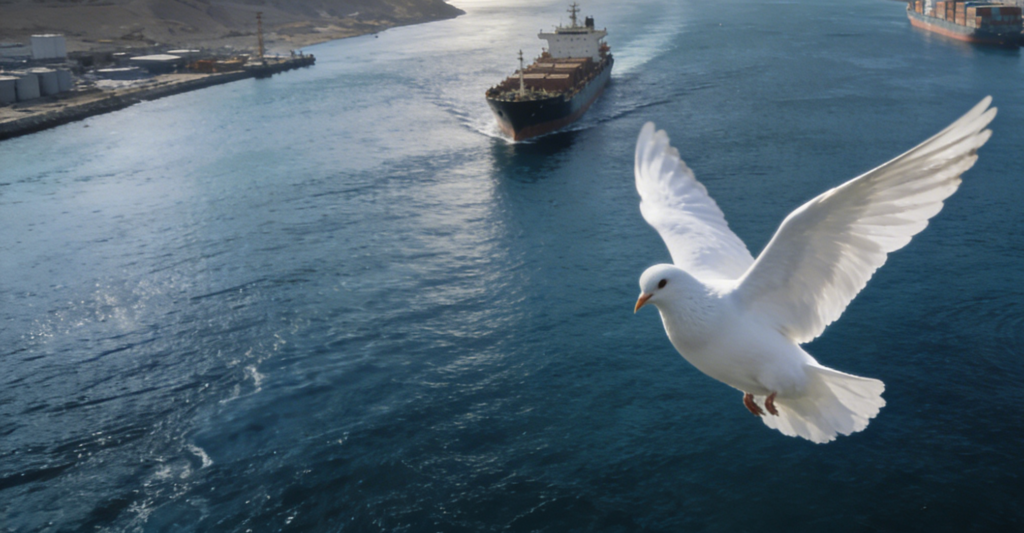
The agreement, brokered with Pakistan playing a central mediating role, came at the eleventh hour — less than 90 minutes before Trump’s stated deadline. Under the terms, Iran has agreed to reopen the Strait of Hormuz to safe commercial shipping traffic, while the U.S. has committed to suspending bombing and offensive operations. “This will be a double-sided ceasefire,” Trump posted on social media, stipulating that the truce is conditional upon the strait’s “complete, immediate, and safe opening.”
Trump Declares ‘Total and Complete Victory’
In an interview with AFP following the announcement, Trump stated that the United States had achieved a “significant diplomatic outcome.” “We’ve made tremendous progress. 100 percent. No question about it,” Trump told AFP when asked about the ceasefire. Trump said the U.S. had received a multi-point proposal from Iran, which he described as a “workable basis on which to negotiate.” He also told AFP that he believed multiple international partners had played a role in facilitating dialogue, adding that sensitive nuclear-related matters would be “appropriately addressed” in any final agreement.
Iran Declares Victory, Presents Multi-Point Plan
Iran’s Supreme National Security Council formally accepted the truce and stated that “Iran has secured important concessions and advanced its core positions through the 10-point framework.” According to the council’s statement, the framework includes U.S. commitments to refrain from aggression, acknowledge Iran’s role in regional maritime security, and address sanctions-related concerns through diplomatic channels.
Iranian Foreign Minister Abbas Araghchi confirmed in a statement that Tehran would halt defensive operations if attacks ceased, and that safe passage through the Strait of Hormuz would be coordinated with Iranian armed forces for the next two weeks. Regarding media reports on the framework’s details, the White House and Iranian officials have provided differing characterizations. Multiple news organizations continue to verify the precise content through official channels.
Negotiations Set for Islamabad
Pakistani Prime Minister Shehbaz Sharif confirmed the immediate ceasefire, effective upon announcement, and invited both Iranian and U.S. delegations to Islamabad on April 10 for further negotiations aimed at reaching a final agreement resolving all disputes. The negotiations are scheduled to begin Friday in the Pakistani capital, building on an earlier Pakistani proposal for an immediate ceasefire followed by a comprehensive accord.
Global Markets React Sharply
The ceasefire announcement triggered immediate reactions across global financial and energy markets. Oil prices declined notably, with WTI crude dropping significantly at the open. Stock markets in Asia advanced — Japan’s Nikkei 225 and South Korea’s KOSPI both posted gains. A-share markets also rallied, with the Shanghai Composite Index closing higher. In the U.S., major indices recovered early losses to close modestly higher, as investors responded to hopes of a diplomatic resolution to the Middle East conflict. Gold prices experienced intraday volatility, with spot gold moving sharply before stabilizing.
Regional Reactions: Cautious Optimism
According to multiple regional media outlets, following the ceasefire announcement, public gatherings were reported in several locations in Iran and Iraq. The reports noted that this marks the first pause in large-scale military operations since late February. However, analysts caution that ground-level tensions remain elevated. Multiple sources indicate that isolated security incidents were reported shortly after the ceasefire announcement, with relevant parties assessing the situation. International observers emphasize the importance of all parties adhering to the truce terms during the two-week window.
UN Welcomes Ceasefire, Calls for Lasting Peace
UN Secretary-General Antonio Guterres welcomed the two-week ceasefire between the U.S. and Iran, urging all parties to work toward a lasting peace in the Middle East, according to AFP. “The United Nations welcomes any de-escalation of hostilities and calls on all parties to build on this moment to achieve a comprehensive and permanent resolution,” a UN spokesperson said.
China’s Role Acknowledged
In his AFP interview, Trump stated that he believes multiple international actors, including China, helped facilitate dialogue. The Chinese Foreign Ministry, in response, said it welcomed the ceasefire, adding that China had consistently supported peaceful resolution of Middle East issues. “China has consistently advocated for an immediate ceasefire and cessation of hostilities, as well as the resolution of disputes through political and diplomatic channels,” ministry spokesperson Mao Ning said at a regular news briefing.
Outlook and Key Risks
While the ceasefire has been welcomed globally, significant diplomatic hurdles remain. Major issues that could affect the truce’s sustainability include Iran’s nuclear program, the future of sanctions, and regional security arrangements — all of which are expected to be central topics in the Islamabad negotiations. Iran has indicated that its defensive capabilities remain robust, though specific assessments vary among international observers. Mediators have noted that building mutual confidence will be critical in the coming phase. For now, the world watches as diplomats prepare to gather in Islamabad, hoping that two weeks of quiet will pave the way for a more lasting peace.